The Notre-Dame Cathedral (Cathedral of Our Lady) in Tournai was mainly constructed in the 12th and 13th centuries. The cathedral was built in the Romanesque style, but also features Gothic elements. At the beginning of the 12th century, there was an exchange of influence between the architecture of Île-de-France, the Rhineland, and Normandy.
The Notre-Dame Cathedral in Tournai is one of the most characteristic examples from this period. The five towers at the intersection of the transept, the central part of the cathedral, are characteristic of the considerable influence of the Tournai Cathedral on cathedrals in northern France and on medieval churches in the Flemish part of Belgium. The Romanesque choir was replaced by a Gothic choir between 1243 and 1255, inspired by the choir of Amiens Cathedral. The nave and transept house the largest collection of sculptures and Romanesque wall paintings in Belgium.
The Notre-Dame Cathedral is a historic pilgrimage church located along the pilgrimage route to Santiago de Compostela. The cathedral was severely damaged by a tornado in 1999. During our visit, the building was covered in scaffolding, both on the exterior and interior. The restoration work began in 2006, which was a major project lasting some twenty years. At the time, taking photos was almost impossible due to the scaffolding and hoardings. The cathedral requires constant maintenance, and regular restoration projects remain necessary. The Notre-Dame Cathedral in Tournai became a UNESCO World Heritage Site in 2000.
www.werelderfgoedfotos.nl © Copyright World Heritage Photos Classic Car Road Trip
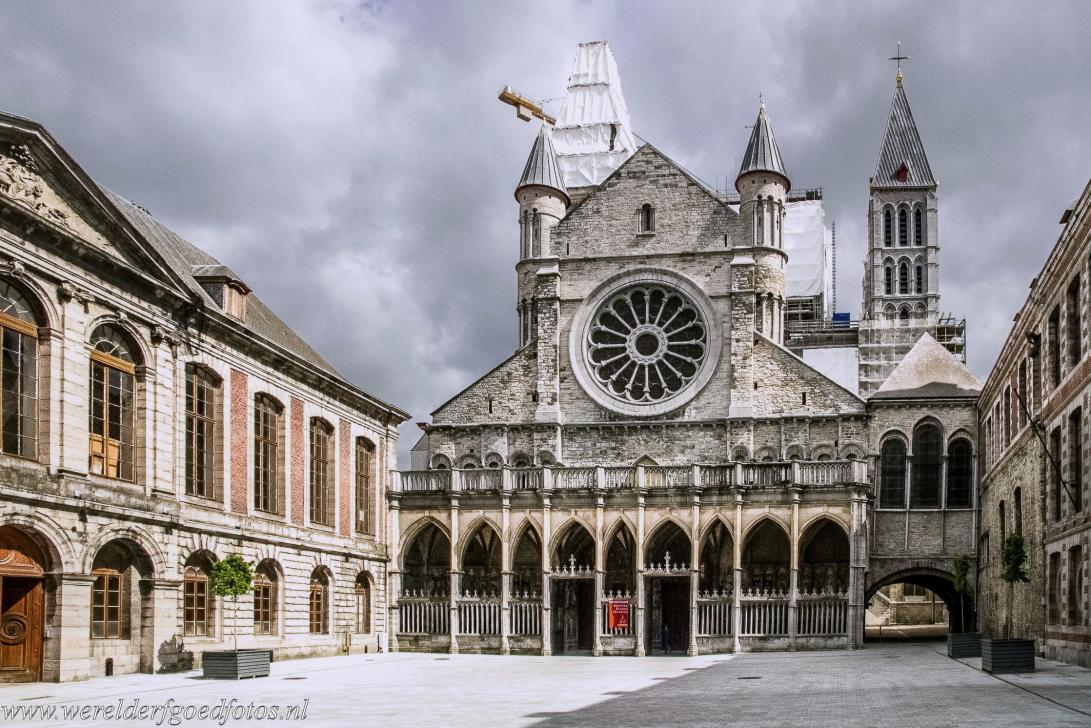
The five towers of the Notre-Dame Cathedral in Tournai dominate the skyline of the Belgian city. In the beginning of the 12th century, preceding the evolution of the Gothic period, there was an exchange of influence between the architecture of Île-de-France, Rhineland and Normandy. The cathedral is one of the characteristic examples from this period. The Notre-Dame Cathedral in Tournai was declared a UNESCO World Heritage Site in 2000.

The five towers of the Notre-Dame Cathedral in Tournai dominate the skyline of the Belgian city. In the beginning of the 12th century, preceding the evolution of the Gothic period, there was an exchange of influence between the architecture of Île-de-France, Rhineland and Normandy. The cathedral is one of the characteristic examples from this period. The Notre-Dame Cathedral in Tournai was declared a UNESCO World Heritage Site in 2000.

The Notre-Dame Cathedral in Tournai hidden behind scaffolding for renovation. The cathedral was severely damaged by a tornado in 1999. The damage also revealed underlying structural problems. Especially endangered was the Brunin Tower, which had leaned by 80 centimetres. Major restoration works have been carried out since 2006. Restoration works on the cathedral will probably last more than twenty years. The Notre-Dame Cathedral in Tournai was inscribed on the UNESCO World Heritage List in 2000.

Notre-Dame Cathedral in Tournai (Cathedral of Our Lady): The stained-glass rose window above the west portal. The Cathedral of Our Lady is adorned with sculptures, several Romanesque wall paintings, a Renaissance pulpit and paintings by Rubens. The treasury of the cathedral houses a collection of religious relics, such as one of the Seven Wonders of Belgium: the gold-plated silver reliquary chest of Our Lady, 'La Châsse de Notre-Dame'. This masterpiece of goldsmithing dates from 1205.

Notre-Dame Cathedral in Tournai: The richly decorated wooden pulpit dates back to the 16th century. The wood carvings depict the three divine virtues, also known as the theological virtues: faith, hope and love (charity). The sounding board above and behind the pulpit is surrounded by wooden sculptures of angels playing trumpets; they represent the heralds of significant events.

Notre-Dame Cathedral in Tournai: The columns of the nave are topped with different decorated capitals. The Tournai Cathedral was largely built in the 12th and 13th centuries. The five towers at the intersection of the transept, the central part of a cathedral, are characteristic of the great influence of the Tournai Cathedral on cathedrals in Northern France, Rhineland in Germany and on a number of medieval churches in the Flemish part of Belgium.

Notre-Dame Cathedral in Tournai: The-14th century west portal is adorned with three rows of sculptures; they were later added to the main façade of the Romanesque nave. The cathedral in Tournai was severely damaged by a tornado in 1999. It has been undergoing extensive repairs and archaeological investigation ever since. The Cathedral in Tournai is a pilgrimage church and is located along the Route of Santiago de Compostela.
