Tallinn – The Baltic Gate of the Hanseatic League
Tallinn is the capital of Estonia, with a historic centre dating back to the 13th century. It was once a prosperous Hanseatic city, situated on the shores of the Gulf of Finland. The medieval town wall was constructed during the 13th and 14th centuries. Today, a 1.9 kilometre stretch of this wall is still standing, including 26 defensive towers and gate towers. Among them is the Kiek in de Kök, one of the prominent towers and once the most powerful cannon tower in the 15th-century Baltic States. The Great Coastal Gate and Fat Margaret's Tower were built to defend Tallinn from the seaward side.
Many historic monuments from the past have been preserved within the medieval town walls of Tallinn. Among them is Tall Hermann, a tower of Toompea Castle on Toompea Hill. The Tallinn Dome Church is also situated on this hill and is the oldest church in the town. St. Olav's Church (Oleviste Kirik) was once the tallest building in the world. Between 1941 and 1991, the Soviet KGB used the spire of this church as a radio tower and surveillance point. The onion-domed Alexander Nevsky Cathedral is the main Russian Orthodox cathedral in Estonia.
In August 1989, the Baltic Way was a human chain linking the three Baltic States in their drive for freedom. The Baltic Way, a 600-kilometre-long human chain from Tallinn to Vilnius, via Riga, was inscribed on the UNESCO Memory of the World Register. The Historic Centre (Old Town) of Tallinn was declared a UNESCO World Heritage Site in 1997.
www.werelderfgoedfotos.nl © Copyright World Heritage Photos
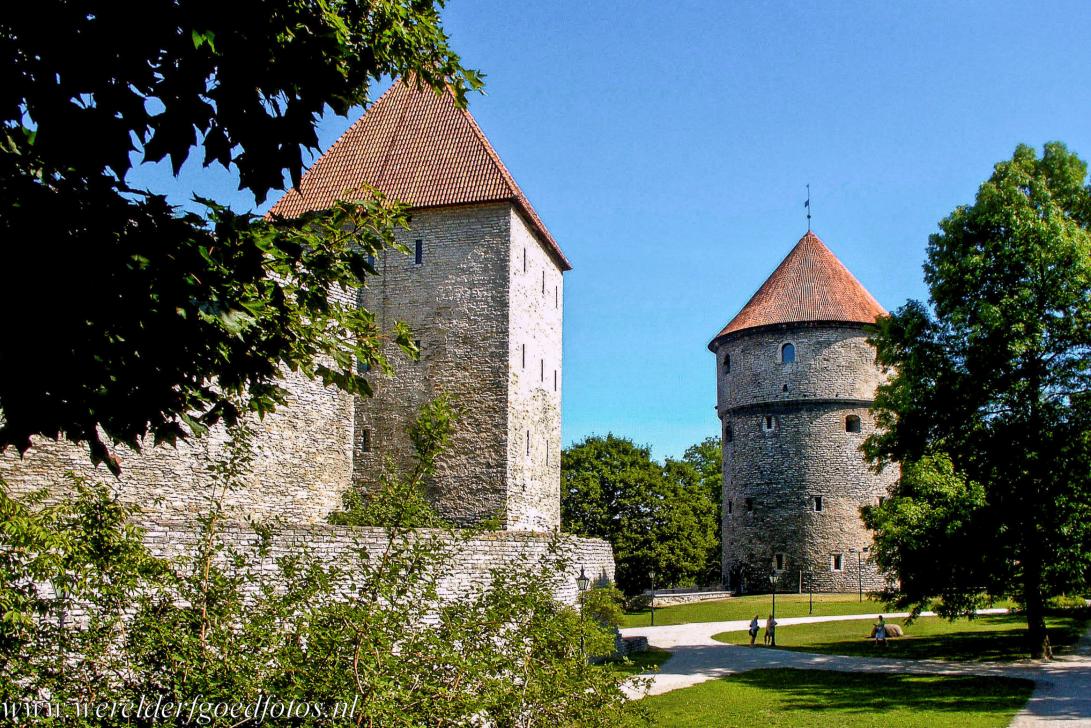
One of the towers of the Tallinn city wall is the Kiek in de Kök (Peep into the Kitchen). The tower was so tall that the soldiers from the top floor could look into the kitchens of the houses down below. The 15th-century Kiek in de Kök was the most powerful cannon tower in the Baltic region at that time. This imposing structure is 38 metres high and has walls more than 4 metres thick. Of the original 46 towers of the city walls, 26 still survive today. The Historic Centre (Old Town) of Tallinn was inscribed on the UNESCO World Heritage List in 1997.

One of the towers of the Tallinn city wall is the Kiek in de Kök (Peep into the Kitchen). The tower was so tall that the soldiers from the top floor could look into the kitchens of the houses down below. The 15th-century Kiek in de Kök was the most powerful cannon tower in the Baltic region at that time. This imposing structure is 38 metres high and has walls more than 4 metres thick. Of the original 46 towers of the city walls, 26 still survive today. The Historic Centre (Old Town) of Tallinn was inscribed on the UNESCO World Heritage List in 1997.

Paks Margareeta (Fat Margaret's Tower) was built in 1510 to defend the northern access to the Old Town of Tallinn. This robust defensive tower has walls up to 5 metres thick. Fat Margaret, together with the nearby Suur Rannavärav (Great Coastal Gate), was intended to protect the city from the seaward side. Much later, Fat Margaret was used as a storage place for gunpowder and weapons, and subsequently it became a prison. Today, this imposing structure houses the Estonian Maritime Museum. The Suur Rannavärav is mentioned in documents as early as 1384.

The Russian Orthodox Alexander Nevsky Cathedral was built in 1900 in the historic centre of Tallinn, right in front of Toompea Castle, today home to the Estonian Parliament. The cathedral features onion-shaped domes, a characteristic element of Russian Orthodox churches. These iconic domes resemble a candle flame, which symbolises light of faith reaching up to heaven. The candle flame also represents the prayers of the faithful drifting up to heaven. Candles are therefore a prominent feature of Russian-Orthodox church services.

The imposing onion-domed Alexander Nevsky Cathedral is the main Russian Orthodox church in Estonia. Its five impressive domes house eleven bells, including the largest bell in Tallinn, which is three metres tall and weighs no less than fifteen tonnes. These massive bronze bells were cast in Saint Petersburg, in the period when Estonia was part of the Russian Empire. The interior of the cathedral is lavishly decorated with mosaics and icons. Unfortunately, photography was prohibited inside the cathedral during our visit.

The Parliament House of Estonia was built in the 1920s and is located in the courtyard of Toompea Castle, in front of the Alexander Nevsky Cathedral. The pink-coloured Parliament House was built on the foundations of the castle's eastern wing. The castle stands on Toompea Hill and dates to the 13th and 14th centuries. A stronghold had already been built on this side in the 9th century. From Toompea Castle, foreign powers ruled over Estonia for seven centuries. The buildings on this hill are situated about 20 to 30 metres higher than the surrounding town.

The Estonian flag flies on Pikk Hermann and symbolises the country's independence. This iconic defensive tower stands at the southwestern corner of Toompea Castle in Tallinn. The tower was built in 1371 and heightened to 45 metres in the 16th century. It is said that Estonia is governed by the power whose flag flies from the top of Pikk Hermann (Tall Hermann). Every day, the blue, black, and white tricolor of Estonia is hoisted on the tower at sunrise and lowered at sunset. For the flag ceremony, the colour guard must climb the 215-step staircase every day.

The 14th-century barbican of Viru Gate (Viru Väravad) with the slender Town Hall Tower of Tallinn in the background. This gate was the main entrance to Tallinn on the east side of the town and was once part of a larger defence system. The Gothic Town Hall (Raekoja) of Tallinn was completed in 1404, while its ower (Raekoja Torn) was built in 1627. It is possible to climb the 64-metres-high tower. A medieval, steep, and exceptionally narrow spiral staircase leads to the belfry balcony, which offers breathtaking views over the historic centre of Tallinn.

The Stable Tower (Tallitorn) is part of the medieval city walls surrounding the historic centre of Tallinn. This unique 14th-century corbelled tower owes its name to the royal stables that were once located behind it. Strategically positioned, the tower served as a lookout point, guarding the vital passage between the Lower Town and the fortified Toompea Hill. In the background stands the square Maiden’s Tower (Neitsitorn), a building that once served as a prison. The city walls and their towers are an important part of the UNESCO World Heritage Site in Tallinn.

The city walls on the northwestern side of Tallinn's old town are well-preserved. The 14th-century Golden Leg Tower (Kuldjala torn) and the Tower Behind the Nuns (Nunnadetagune torn) located behind it once guarded the city. In the Middle Ages, the Square of Towers (Tornide väljak) was known as the Nuns' Meadow and consisted of the grassy area next to these towers. The city walls date back to the 13th and 14th centuries and were constructed concurrently with the Great Coast Gate, which was designed to impress travelers arriving by ship.

Tallinn Cathedral stands on Toompea Hill and is dedicated to Saint Mary. The cathedral, locally known as Toomkirik, is the oldest church building in Tallinn and also the main Lutheran church in Estonia. The first stone church on this site was elevated to the status of a cathedral as early as 1240. Although the building survived the Reformation, it did not escape the city fire of 1684. Only the 14th-century vaulted nave was spared. The cathedral was subsequently rebuilt in a blend of styles, with its 69-metre-high Baroque tower not being added until the 18th century.

The Tallinn Dome Church, or St. Mary's Cathedral, was originally built in the 13th century when the Danes invaded Tallinn. The Danish king designated the church as the Cathedral of the Virgin Mary. Following the departure of the Danes, the city was dominated by the German nobility until 1918. They made the cathedral their exclusive place of worship, a fact still evidenced by the family coats of arms displayed on its walls. The cathedral’s altar, pulpit and chandeliers date back to the 17th century. The Ladegast organ was built in 1878 and subsequently modernised by Wilhelm Sauer in 1914. The sound of this organ is renowned among music enthusiasts, and the cathedral frequently hosts concerts.

The tower of St. Olav's Church (Oleviste Kirik) is considered one of the symbols of Tallinn. From 1549 to 1625, the church boasted the tallest church tower in the world. It was struck by lightning about ten times, three of which resulted in massive fires. Following a devastating fire in 1820, its height was reduced from 159 to 123.7 metres. The church is dedicated to the Norwegian King Olaf II Haraldsson, the patron saint of Norway. From May to October, visitors can climb the 258 steps of the spiral staircase to the top of the tower, where a platform offers amazing views over the historic centre of Tallinn, a UNESCO World Heritage Site.

Because St. Olaf’s Church had an exceptionally tall tower, it served as a maritime signpost for Hanseatic merchant ships arriving via the Gulf of Finland. During the Soviet occupation from 1944 to 1991, this striking tower was used by the KGB as a radio tower and observation post. They installed various types of equipment to spy on the city and maritime traffic, as well as to block radio communications with the West. Their headquarters in Tallinn were located right next to the tower, which has since been tranformed into a poignant museum.

The Gothic St. Olaf’s Church (Oleviste Kirik) is located in the Old Town of Tallinn. During the Reformation in 1524, the church became Lutheran, leading to the removal of most of its Catholic altars and relics. Following a fire in 1820, the interior was rebuilt by 1830. The current organ was constructed between 1840 and 1842 in a Neo-Gothic style by the famous organ builder Walcker. The organ's dark wooden case is beautifully decorated with Gothic pointed arches and pinnacles. The 31-metre-high star vault that extends above the nave dates back to the 15th century and survived the fire.
