World Heritage Photos

City of Graz - Historic Centre

City of Graz - Historic Centre and Schloss Eggenberg: Graz is situated on the banks of the River Mur in the southeastern part of Austria. It is the country's second-largest city after Vienna. The city is situated at the crossroads between Central Europe, Italy and the Balkan States. The historic centre of Graz is famous for its harmonious blend of several architectural styles. Since the Middle Ages, each century is represented by typical buildings. The historic centre of Graz is one of the best-preserved city centres in Central Europe. Schloss Eggenberg lies on the western edge of Graz. The 17th-century schloss was built by Hans Ulrich von Eggenberg as a symbol of his status in the Imperial Court. Graz is situated along the Semmering Railway, also a UNESCO World Heritage Site. The City of Graz - Historic Centre became a UNESCO World Heritage Site in 1999. The UNESCO World Heritage Site was extended in 2010 to include Schloss Eggenberg.

www.werelderfgoedfotos.nl   © Copyright   World Heritage Photos
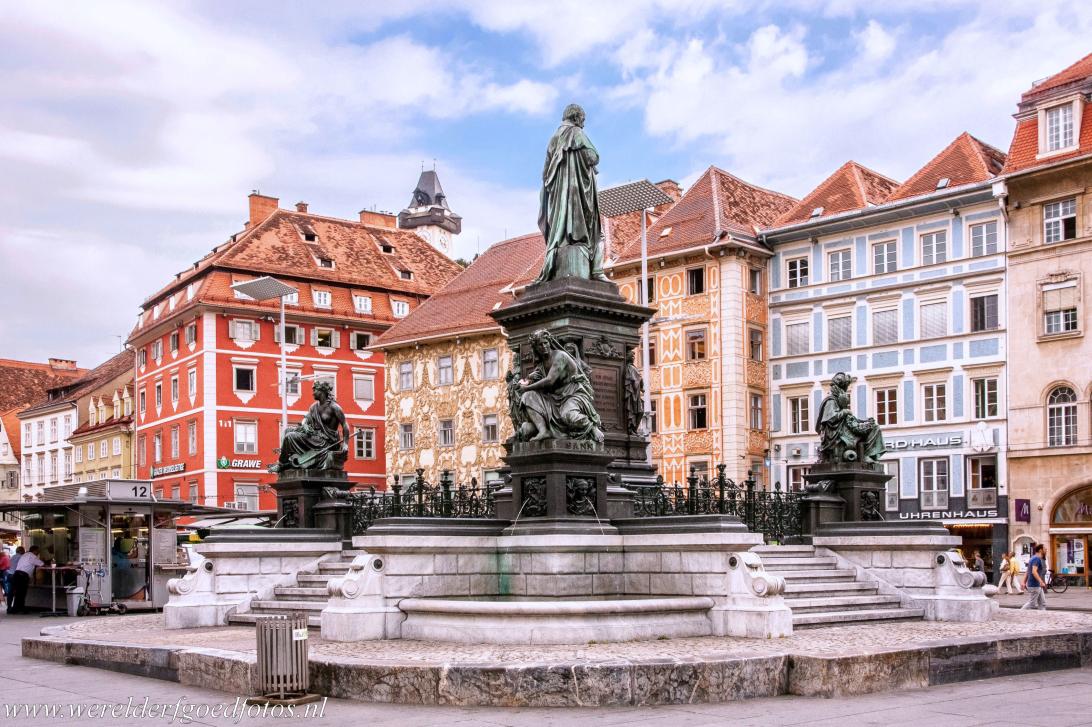
City of Graz - Historic Centre - City of Graz - Historic Centre: The Hauptplatz is the market square of Graz; it was created in the Middle Ages. The monumental Erzherzog...

City of Graz - Historic Centre: The Hauptplatz is the market square of Graz; it was created in the Middle Ages. The monumental Erzherzog Johann Fountain has adorned the market square since 1878. In the Middle Ages, Graz was an important centre of trade. Traders displayed their wares beneath  wooden shopping arcades. The two Luegg Houses now feature masonry arcades; the Luegg House on the corner of the market square is adorned with a 17th-century stucco façade.

  1. City of Graz - Historic Centre - City of Graz - Historic Centre: The Hauptplatz is the market square of Graz; it was created in the Middle Ages. The monumental Erzherzog...

    City of Graz - Historic Centre: The Hauptplatz is the market square of Graz; it was created in the Middle Ages. The monumental Erzherzog Johann Fountain has adorned the market square since 1878. In the Middle Ages, Graz was an important centre of trade. Traders displayed their wares beneath  wooden shopping arcades. The two Luegg Houses now feature masonry arcades; the Luegg House on the corner of the market square is adorned with a 17th-century stucco façade.

  2. City of Graz - Historic Centre - City of Graz - Historic Centre: The 13th-century Clock Tower on the 473-metre-high Schlossberg towers high above the historic city of Graz. The...

    City of Graz - Historic Centre: The 13th-century Clock Tower on the 473-metre-high Schlossberg towers high above the historic city of Graz. The monumental Clock Tower is a bell tower and a landmark of the city. The Schlossberg is the hill in the centre of Graz; it offers breathtaking views over the city. The City of Graz - Historic Centre gained status as a UNESCO World Heritage Site in 1999. 

  3. City of Graz - Historic Centre - City of Graz - Historic Centre: The Landhaus and its elegant Renaissance arcaded courtyard. In the courtyard stands a bronze fountain, a...

    City of Graz - Historic Centre: The Landhaus and its elegant Renaissance arcaded courtyard. In the courtyard stands a bronze fountain, a true Mannerist work of art. The construction of this prestigious building for the Styrian State began in 1557. Today, the imposing Landhaus building still houses the provincial parliament of Styria; the courtyard is used for events such as concerts. Graz is the capital city of Styria (Steiermark), a federal state (Bundesland) of Austria. 

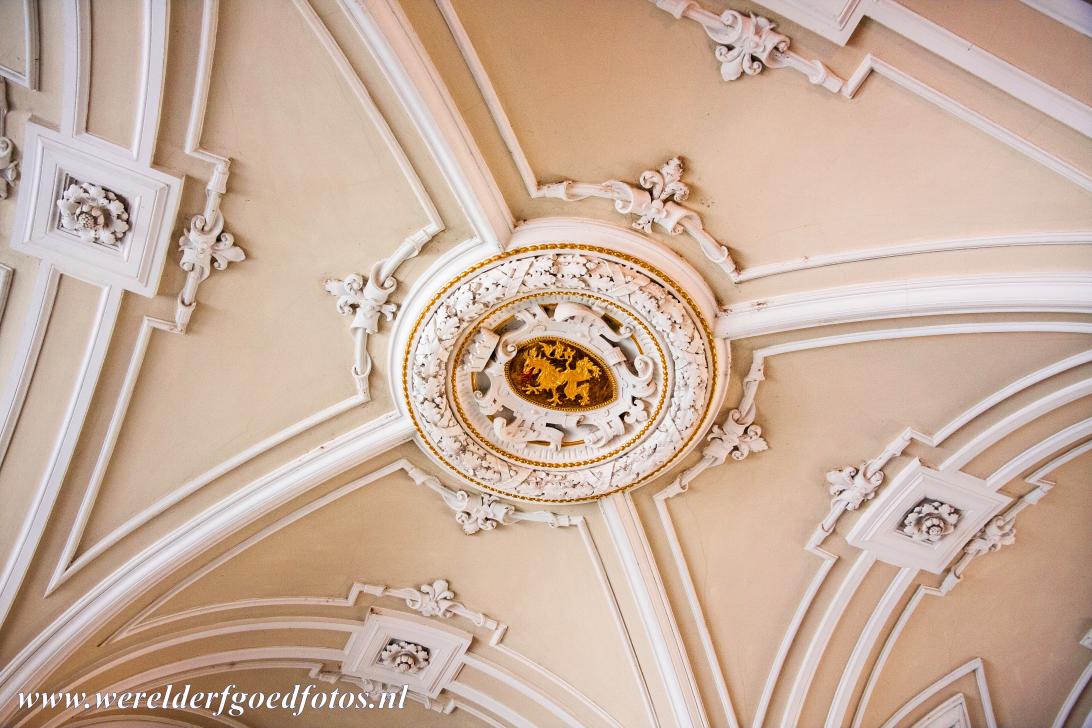
  4. City of Graz - Historic Centre - City of Graz - Historic Centre: The decorated vaulted ceiling of the Graz Town Hall. With its dome and corner towers, this iconic building has...

    City of Graz - Historic Centre: The decorated vaulted ceiling of the Graz Town Hall. With its dome and corner towers, this iconic building has dominated the city since the late 19th century. The façade of this impressive building is adorned with statues depicting prominent Austrians. The town hall stands at the market square and serves as the seat of the Mayor of Graz; there is also a café in the courtyard.

  5. City of Graz - Historic Centre - City of Graz - Historic Centre: The Holy Roman Emperor Ferdinand II, a member of the House of Habsburg, was interred in the Imperial...

    City of Graz - Historic Centre: The Holy Roman Emperor Ferdinand II, a member of the House of Habsburg, was interred in the Imperial Mausoleum in Graz in 1637. However, his heart rests in the Herzgruft (the Heart Crypt) of the Church of the Augustinian Friars in Vienna, where the hearts of nearly all Habsburgs are placed. This impressive Mannerist mausoleum is connected to St. Catherine's Church, one of the most important 17th-century buildings in Austria because its oval dome was the first of its kind in the country.

  6. City of Graz - Historic Centre - City of Graz - Historic Centre and Schloss Eggenberg: The Imperial Mausoleum was constructed between 1614 and 1636. It was commissioned by...

    City of Graz - Historic Centre and Schloss Eggenberg: The Imperial Mausoleum was constructed between 1614 and 1636. It was commissioned by Archduke Ferdinand II of Habsburg, who later became Holy Roman Emperor. This iconic mausoleum is a masterpiece of art and architecture; it features Renaissance, Mannerist and Baroque styles. Its oval dome is embellished with amazing frescoes. The crypt is accessible via a spiral staircase and houses the tombs of Ferdinand II and several members of his immediate family. 

  7. City of Graz - Historic Centre - City of Graz - Historic Centre and Schloss Eggenberg: Schloss Eggenberg, or Eggenberg Palace, is situated in a romantic park on the...

    City of Graz - Historic Centre and Schloss Eggenberg: Schloss Eggenberg, or Eggenberg Palace, is situated in a romantic park on the outskirts of Graz. The historic centre of the city of Graz was declared a UNESCO World Heritage Site in 1999. In 2010, the world heritage site was extended to include Schloss Eggenberg, the most renowned palace complex of Styria. The historic centre of the city of Graz is famous for its harmonious blend of a number of architectural styles.

  8. City of Graz - Historic Centre - City of Graz - Historic Centre and Schloss Eggenberg: Crystal chandeliers in the Planetary Room, one of the many rooms of Schloss Eggenberg....

    City of Graz - Historic Centre and Schloss Eggenberg: Crystal chandeliers in the Planetary Room, one of the many rooms of Schloss Eggenberg. The palace was built in the 17th century by Hans Ulrich von Eggenberg as a symbol of his status at the Imperial Court. Schloss Eggenberg has a Baroque interior. The palace houses European art from the Middle Ages to the Enlightenment; it also houses a Coin Cabinet and an Archaeology Museum. 

  9. City of Graz - Historic Centre - City of Graz - Historic Centre and Schloss Eggenberg: Schloss Eggenberg, Eggenberg Palace, has 365 windows, 31 rooms on each floor, 24 state rooms...

    City of Graz - Historic Centre and Schloss Eggenberg: Schloss Eggenberg, Eggenberg Palace, has 365 windows, 31 rooms on each floor, 24 state rooms with 52 doors and 4 corner towers. They all refer to time: the 365 days of the year, the 31 days of the longest months, the 24 hours of the day, the 52 weeks or the number of Sundays in a year and the four seasons. Eggenberg Palace is surrounded by gardens, among them the Planetary Garden in the north corner of the park.